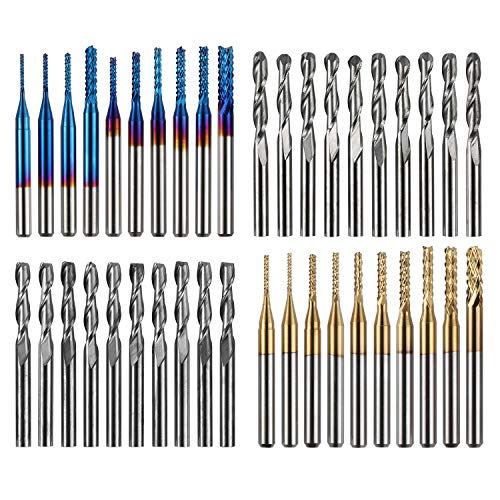
Genmitsu · Router Bits
Genmitsu 10pc Nano Blue Flat Nose End Mills
$34.19
at Amazon

Whether the 3018-PROVer V2 is right for you comes down to what you actually cut and how much of the setup you want to own yourself. The lists below are drawn from this machine's real specification and its real gaps - not from marketing.
3018-PROVer V2 carries a spindle, but Genmitsu does not publish a power rating for it, and we will not substitute a wattage from a marketplace listing to fill the gap. Nor is a speed range published, which leaves the cutting envelope genuinely unspecified. A spindle you cannot size is a spindle whose depth-of-cut and feed limits you will have to find empirically, starting conservative and listening for the machine to complain.
Treat that missing figure as information rather than an oversight: on a machine sold to learn on it matters less, because you will be taking light passes anyway, but it is the reason the score on this page excludes spindle power rather than guessing at it. If your work depends on knowing you have the power for deep hardwood passes or aluminium, buy a machine whose maker stands behind a number.
Genmitsu does not state whether the 3018-PROVer V2 runs closed-loop or open-loop steppers, and that gap matters more than most unpublished figures. The loop type decides whether the machine can detect a lost step or merely hopes it has not taken one - the difference between a scrapped aluminium part and a sound one. We exclude the motor component from the score rather than assume, and you should treat any claim that it handles metal as untested until the drive type is on the maker's own sheet.
And an all aluminium frame is rigid enough for the machine's intended work while keeping it liftable. Rigidity is a chain, and the machine is only as accurate as its weakest link in that chain - a ball screw guided by V-wheels is still limited by the V-wheels.
The open-loop trade-off is the argument the best CNC routers for metal list is built around.
At 290 × 180mm the 3018-PROVer V2 is well short of sheet-goods territory - this is a bed for small parts, signage, inlays and jewellery-scale work rather than furniture panels. The number to translate is not the footprint on your bench but the piece you can actually reach with the cutter: published envelopes shrink in practice once clamps, the dust shoe and the spoilboard eat into them, so budget perhaps 20mm of real working margin on each axis before a job stops fitting.
The 40mm of Z travel is the real constraint here: it is the figure most likely to stop a job outright, ruling out thick stock and most workholding that sits under the cut. Confirm your tallest part clears before you buy, not after.
Genmitsu does not state a material range for the 3018-PROVer V2, and rather than infer one from the frame and drives we leave the material-breadth component unscored. That absence is worth reading honestly: a maker confident a machine cuts aluminium usually says so, because it sells machines. Take the mechanics on this page as the real guide - a rigid, closed-loop platform will handle metal that an open-loop one should not, whatever a listing title claims.
The feeds and speeds still apply whatever you end up cutting, so start from the material calculators and confirm every number against your own controller and a test cut before committing to real stock.
This score rests on 52% of the model, and that figure is the most important thing on the page after the score itself. What scored - work area, rigidity and value - comes from published figures. What did not - spindle power, motor quality and material breadth - is unpublished, and we exclude it and renormalise across the rest rather than scoring it zero, because punishing a machine for a fact we simply do not know would be the opposite of honest.
Concretely: with spindle power unscored, the score says nothing about how hard the machine can actually cut - a real gap, since cutting power is half of why you buy one, with the motor type unpublished, the score cannot tell you whether the drive can catch a lost step, which is the difference between a machine you can trust in metal and one you cannot and with no stated material range, the breadth component is excluded, so the score reflects how well it does its stated work rather than how much work it can do. The number is honest about the machine's stated strengths and silent on everything the maker left off the sheet.
The 3018-PROVer V2 earns its place on the strength of a genuinely low cost of entry that makes the inevitable early mistakes cheap. Where it asks for a clear head is the compromise: the shallow Z travel will decide more of your projects than the score does. Bought for the work it is actually built for, it is a sound machine; bought for work it quietly cannot do, it will disappoint in exactly the way its unpublished or open-loop specs warn it might. Match it to your material and it holds up.
The reference figures. Missing values show as not published - we do not estimate them.
| Work area X | 290 mm (11.42″) |
|---|---|
| Work area Y | 180 mm (7.09″) |
| Z travel | 40 mm (1.57″) |
| Spindle power | Not published The manufacturer does not publish a spindle power rating for this machine. |
| Spindle speed | Not published |
| Motor type | Not published |
| Frame | all aluminium |
| Materials stated | Not published |
| Manufacturer list price | $269.00 |
| Spindle | 775 spindle, 42mm diameter (power not rated by manufacturer) |
|---|---|
| Psu | 24V / 4A |
| Control board | 32-bit |
| Assembly minutes | 20-35 |
| Included | 4 clamps, 10 x 20-degree V-bits |
Each component scored against an absolute reference scale, then renormalised across the components that were published.
| Component | Weight | Score |
|---|---|---|
| Work area | 22 | 30 |
| Spindle power | 18 | Not scored - spec unpublished |
| Motor quality | 16 | Not scored - spec unpublished |
| Material breadth | 14 | Not scored - spec unpublished |
| Rigidity | 15 | 20 |
| Value | 15 | 100 |
Matched by collet and shank size - the consumables you will actually be re-ordering.
Every specification on this page is transcribed from the manufacturer's own published sheet: www.sainsmart.com · verified July 27, 2026. Marketplace listings, forums and news aggregators are never sources of record.
Scores are computed from published specifications by a formula we document on the methodology page. No brand can pay for a position.