#1
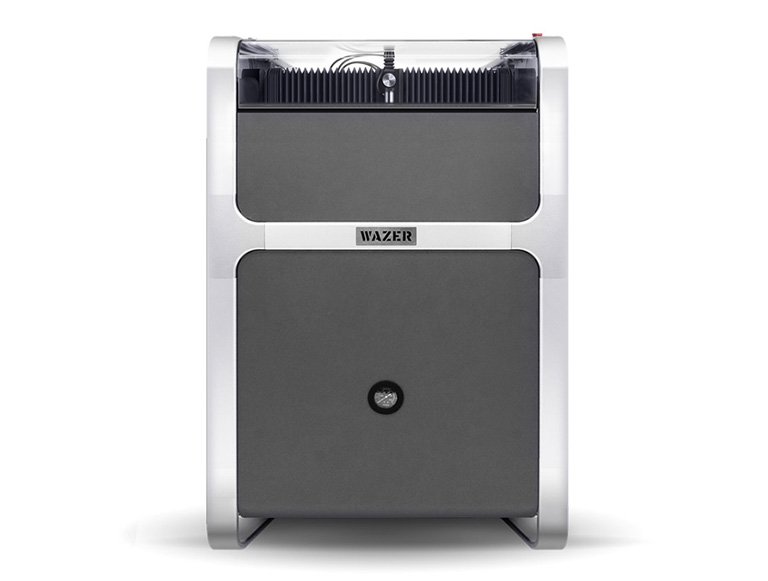
66/100
WAZER · Best waterjets
the buyer who would rather have documentation and support than a higher number.
- No spindle

2 machines · Updated August 1, 2026
Ordered by overall computed waterjet score
Ranked by our waterjet score - material versatility, cut thickness, cutting area, speed and value. The desktop waterjet is a specialised category, effectively defined by WAZER, and its appeal is singular: it cuts almost any material - metal, stone, tile, glass, composites - cold, with an abrasive water stream rather than heat, so there is no warping, no heat-affected edge and no cracking of brittle material. That versatility is why it is weighted at the top of the score. The trade is speed and mess: a waterjet is slow and wet, consumes garnet abrasive continuously as its main running cost, and needs plumbing and abrasive collection rather than sitting on a bench like an appliance. If you only ever cut one conductive metal, a plasma table is faster and cheaper; if you cut a mix of materials and cannot tolerate heat distortion, nothing else in this size class does what a waterjet does.
Ordering is computed from published specifications. No brand can pay for a position here.
the buyer who would rather have documentation and support than a higher number.
the buyer who would rather have documentation and support than a higher number.
Every measure that decides this category, for all 2 machines at once.
| Machine | Score | List price | Work area |
|---|---|---|---|
| WAZER Pro | 66 | $18,999.00 | — |
| WAZER Desktop | 57 | $9,999.00 | — |
| Lowest list price | WAZER Desktop The entry point - and the envelope is the reason it is cheap, not a compromise in build. |
|---|---|
| Highest computed score | WAZER Pro Tops the model, but on 76% coverage - strong on what is published rather than proven throughout. |
| Best score per dollar | WAZER Desktop The most computed capability per pound spent - not the same question as which machine is best. |
A CNC router is a gantry that moves a spinning cutter through three axes under G-code control. What separates one from another is almost never the software - most desktop machines run GRBL and accept the same toolpaths - but the mechanics: how the motion is driven, how rigidly the gantry resists the cutting forces pushing back at it, and whether the controller knows where the tool actually is rather than where it commanded it to be.
Drive type is the clearest dividing line. Belts are cheap, forgiving of a crash and quick to replace, but they stretch under load. Lead screws are stiffer and slower. Ball screws are stiffer again and back-drive far less, which is why they appear on machines aiming at metal or at precision in hardwood.
Control is the other. An open-loop stepper is told to move and assumed to have moved; a closed-loop one reports back, so the controller knows when a step was lost and can correct it. On wood the difference is often invisible. On anything where the part has to be dimensionally right, it is the whole ballgame.
The order on this page is computed, not curated. Every machine is scored from the specifications its manufacturer publishes, using weights documented in full on the methodology page, and no brand can pay to move up. The affiliate links on this site never touch the score - ranking and monetisation are calculated by separate functions that do not share data.
The caveat that matters most is coverage. Our model excludes any component a maker has not published rather than scoring it zero, then renormalises across what is left - so a machine scored on 76% of the model is not directly comparable to one scored on 100%. 2 of the 2 machines here fall short of full coverage. Read a high score on thin coverage as "strong on what we can verify", not as a verdict on the whole machine, and treat the gap as an unknown you would be inheriting.
Prices are dated observations refreshed daily from retailer APIs, not live quotes, and anything unconfirmed for more than 72 hours is labelled availability-unknown rather than shown as current. Specifications come from manufacturer product pages only - never from marketplace listing copy, which is written to sell rather than to describe.
This list sorts on the overall waterjet score, a weighted blend of material versatility (24), cut thickness (22), cutting area (24), speed (16) and value (14). Material versatility leads because cutting anything cold is the whole reason to own a waterjet. Where a maker hides its cutting-area figures behind a spec table we cannot read, that axis is left unscored and the coverage the machine does publish carries the number, so the score reflects only what is verifiable.
The full weighting model and the reference scales are on the methodology page.
