Genmitsu
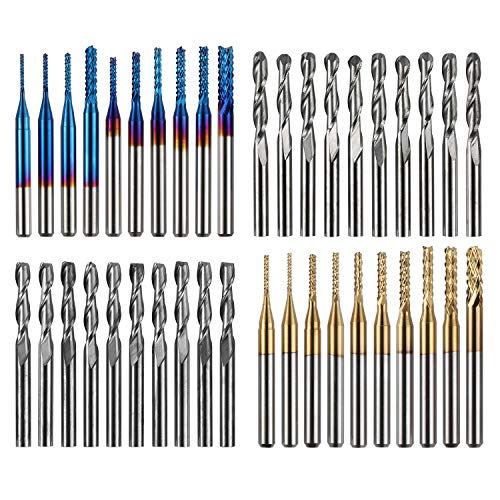
Genmitsu 10pc Nano Blue Flat Nose End Mills
Ten identical flat-nose cutters. Buying one geometry in bulk is how you stop treating bits as precious and start running the feed rate the chart actually recommends.
$34.19
at Amazon

End mills, V-bits and profile cutters — the thing you replace most often.
The decision is made in a fixed order, and getting it out of order is what leads to a drawer of bits you never use. Shank size comes first because it is decided by your machine, not by preference - the collet in your spindle accepts one diameter and no adapter runs the wrong way. Geometry comes second, decided by the material and the finish you need. Coating and flute count come last, and matter far less than either of the first two.
The single most common mistake is buying a large assortment early. A forty-piece set looks like value and is mostly an education in which five geometries you actually reach for. Once you know that, buying those five in quantity costs less per cut and means you stop treating cutters as precious - which matters, because a cutter you are afraid to break is a cutter you will run too slowly, and running too slowly is what burns the work.
Each geometry carries its own chip-load penalty - the feed & speed calculator applies them and shows the factor separately.
Shank diameter is set by the collet in your spindle, and the two common sizes - 1/8-inch (3.175mm) and 1/4-inch (6.35mm) - are not interchangeable. A 1/4-inch shank is meaningfully stiffer and deflects less on a deep pass, which is why larger machines standardise on it, but it will not physically enter a smaller collet. Machines with an ER11 collet nut can usually take both by swapping the collet itself, which is a five-dollar part rather than a new spindle.
Cutting diameter is a separate figure from shank diameter and the two are frequently different on the same bit - a 1/8-inch cutting diameter on a 1/4-inch shank is a common and useful combination, giving you fine detail with a stiff shank. Read both numbers before ordering.
Every product below lists the machines it fits; machine pages list the consumables matched to their collet. Browse the machine database to check yours.
The honest answer for a first purchase is one assortment, then quantity. Buy a modest set to find out which geometries your work actually needs, then re-buy those in multiples. Ten identical cutters of the geometry you use daily is a better inventory than forty singles, because it removes the temptation to nurse a dull bit through one more job.
Budget for cutters as a running cost rather than a one-off. Abrasive materials - MDF, and anything with glass fibre in it - consume edges far faster than hardwood, and a dull cutter does not announce itself. It shows up as a fuzzy edge on a job that was cutting cleanly an hour earlier.
Ten identical flat-nose cutters. Buying one geometry in bulk is how you stop treating bits as precious and start running the feed rate the chart actually recommends.
Four flutes put twice the cutting edges of a 2-flute into the same rotation, so the feed rate has to double to hold the same chip load. Use the calculator before you run these - a 4-flute at 2-flute feeds will rub and burn.
This listing was out of stock at the last check. The link is kept so you can see whether it has returned.
Eight cutters rather than forty, chosen rather than assorted. The better buy once you know which three bits you actually reach for.
A 1/4-inch shank collection for machines that have outgrown 1/8-inch tooling. The larger shank is stiffer, deflects less and survives the deeper passes a rigid machine can actually take.
The default first bit purchase for anyone on a 1/8-inch machine. Forty cutters means you can afford to snap a few while you learn what a chip load actually feels like, which you will.
Two angles, and the cheapest possible entry into V-carved lettering. Remember that a V-bit's effective diameter changes with depth, so treat any single chip-load figure as an upper bound.
Profile and V-carving geometry rather than end mills. This is the set that turns a machine that cuts shapes into one that carves relief work.
Downcut geometry presses the top fibres down for a clean edge, at the cost of packing chips into the slot. Drop the feed about 30% against an upcut - the calculator does this for you.
Upcut at the tip and downcut above it, so plywood comes off the machine with both veneers intact. The one bit that solves sheet-goods tear-out outright - provided your first pass is deep enough to reach the compression zone.
Chip-load ranges differ per material - pick yours before the first cut.