Fabrication Machines
Onefinity

Onefinity Elite Journeyman Review: Specs, Score & Price (2026)

  • 1,245 × 838 mm
  • 163 mm Z
  • No spindle
  • Mid-range hobbyist

Is the Elite Journeyman right for you?

Whether the Elite Journeyman is right for you comes down to what you actually cut and how much of the setup you want to own yourself. The lists below are drawn from this machine's real specification and its real gaps - not from marketing.

Buy it if
  • You want a drive that detects a lost step and stops rather than cutting on from a position it no longer holds - the single feature that most reduces silently-ruined parts.
  • You care about holding tolerance over a long job: ball screws have effectively no backlash, so the machine returns to the same coordinate pass after pass.
  • Your work involves sheet goods and you are tired of tiling large jobs into pieces the bed can reach.
Look elsewhere if
  • You want one box that cuts on arrival: this one ships without a spindle or a table, and both are decisions - and costs - you take on separately.
  • You want a score you can lean on without caveats: too much of this machine's specification is unpublished for the number to be a full measurement.

Spindle & cutting power

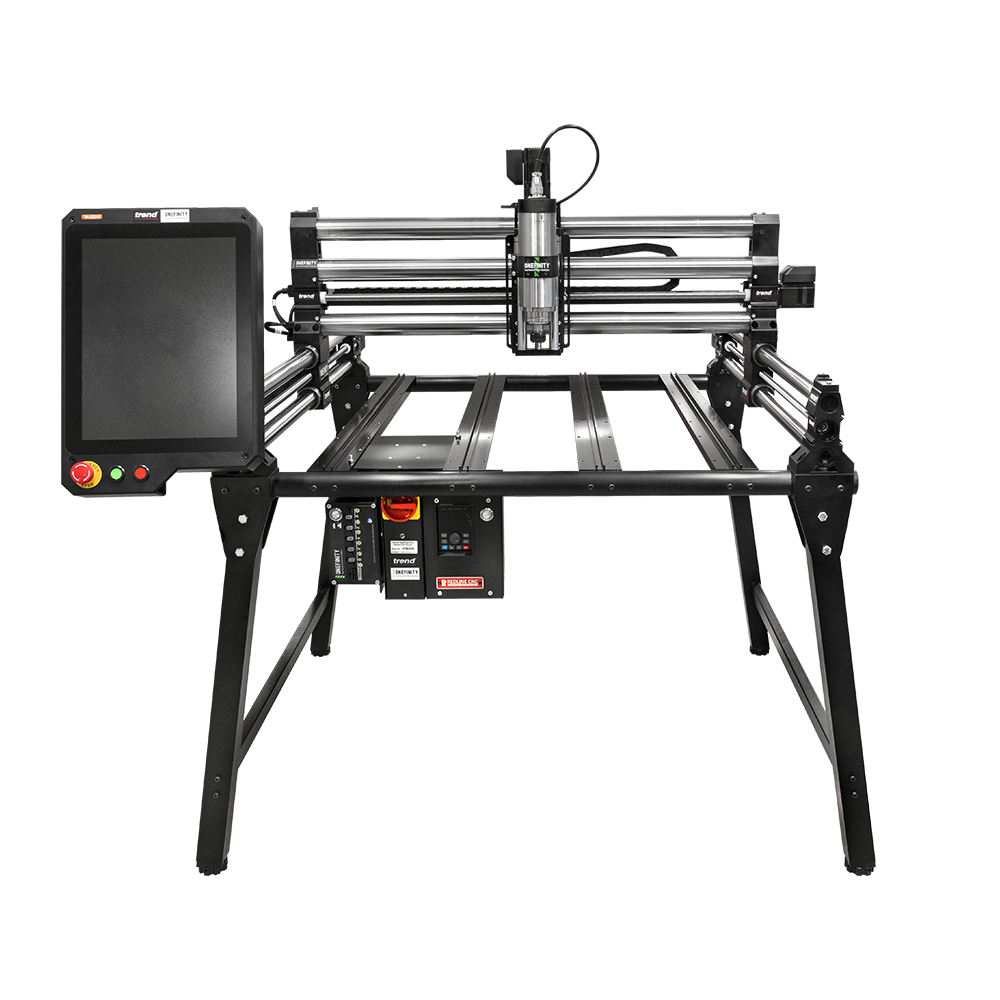
The Elite Journeyman ships without a spindle, and that is not a blank cell to skip past - it is the single most important thing to understand before you compare its price to anything else. What the sticker buys is the motion platform: the frame, the drives, the rails and the controller. The part that actually removes material, you specify and pay for separately. A machine listed a few hundred dollars higher that includes a rated spindle can easily be the cheaper machine once both are cutting.

That absence also front-loads a decision onto your first day of ownership. A router mount takes a trim router for the least money and the most noise; a VFD spindle costs more but runs quieter, holds speed under load and can be commanded by G-code. Choosing well means already knowing your material - a spindle sized for aluminium is overkill for signage in MDF, and a trim router that is fine in plywood will struggle in a sustained hardwood pass. This is why the machine suits a second-time buyer far better than a first: it asks you to make spindle and table decisions that experience makes easy and inexperience makes expensive.

Rigidity & motion system

The motion system on the Elite Journeyman runs closed-loop, which is the single spec that most changes what the machine can be trusted to do. A closed-loop drive reads the actual position of each axis and corrects it; if the cutter meets a hard patch and the motor is nudged off a step, the machine knows and recovers instead of carrying on from a coordinate it has silently lost. That is worth most in metal, where a lost step does not leave a visible flaw you can sand out - it scraps the part, usually deep into a job, and often snaps the tool doing it.

Ball screws convert rotation to motion with effectively no backlash, so the axis returns to the same place every pass - the mechanical basis for holding a tolerance rather than merely getting close to it; profile linear rails are the rigid choice for guideways - a rail-and-block system resists twist and load far better than the alternatives and is the reason this frame can carry a real cut. Rigidity is a chain, and the machine is only as accurate as its weakest link in that chain - a ball screw guided by V-wheels is still limited by the V-wheels.

The open-loop trade-off is the argument the best CNC routers for metal list is built around.

Work area & what fits on it

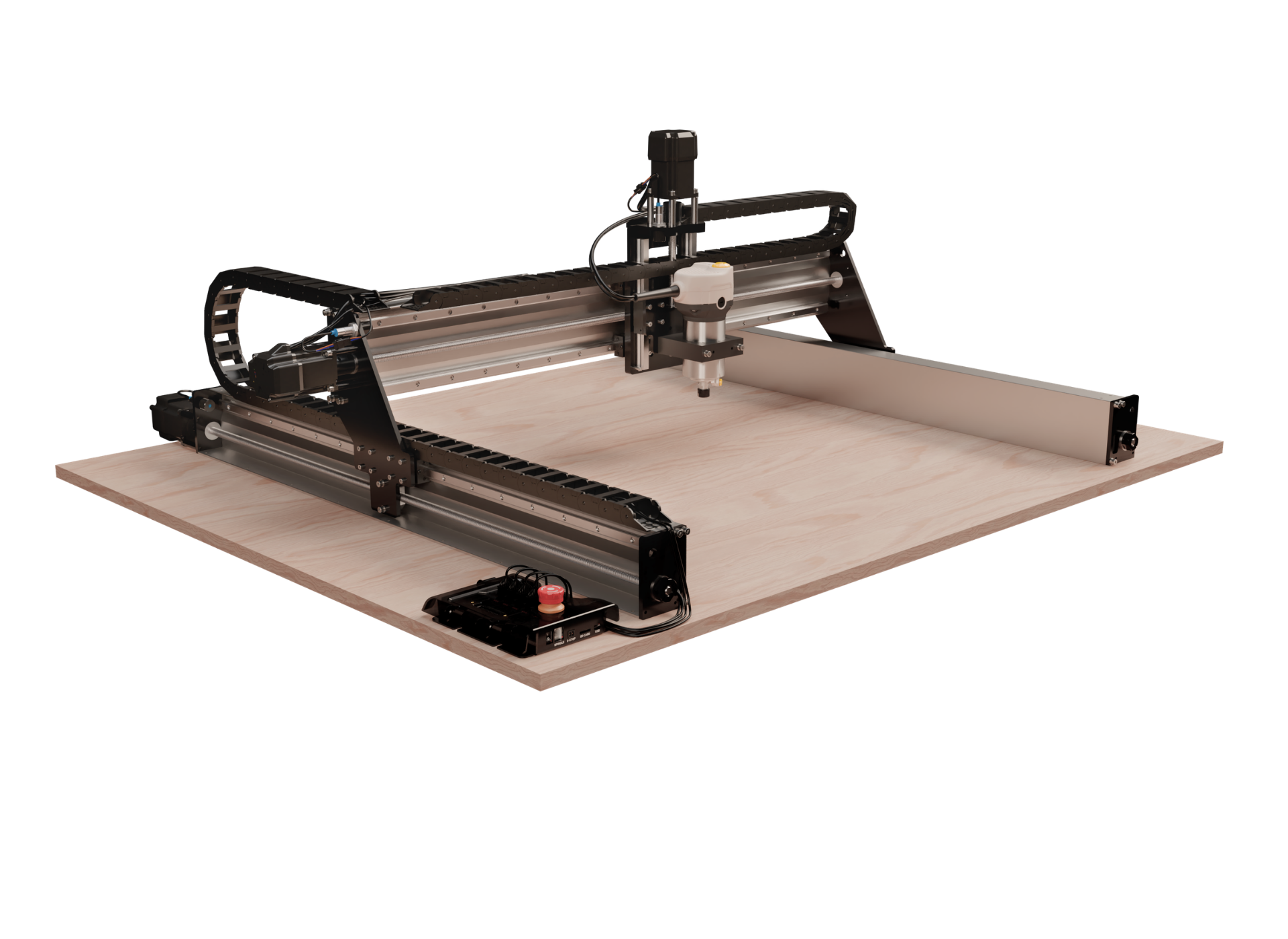
At 1,245 × 838mm the Elite Journeyman takes about 69% of the short dimension of a full 1220mm sheet - a genuinely useful piece without tiling the job into tiny reachable squares. The number to translate is not the footprint on your bench but the piece you can actually reach with the cutter: published envelopes shrink in practice once clamps, the dust shoe and the spoilboard eat into them, so budget perhaps 20mm of real working margin on each axis before a job stops fitting.

The 163mm of Z travel is generous for a desktop machine - enough for thick stock, a workholding jig underneath, or a tall finishing tool without re-fixturing.

A bed this size is also a long lever. The gantry has to span 1,245mm and stay square while a cutter pushes sideways against it, and span always costs rigidity - the biggest machine is rarely the most accurate one. Keep in mind that the middle of a long span deflects more than the ends, so the most demanding cuts do best nearer where the gantry is stiffest.

Materials it handles

Onefinity does not state a material range for the Elite Journeyman, and rather than infer one from the frame and drives we leave the material-breadth component unscored. That absence is worth reading honestly: a maker confident a machine cuts aluminium usually says so, because it sells machines. Take the mechanics on this page as the real guide - a rigid, closed-loop platform will handle metal that an open-loop one should not, whatever a listing title claims.

The feeds and speeds still apply whatever you end up cutting, so start from the material calculators and confirm every number against your own controller and a test cut before committing to real stock.

What the score reflects - and what's missing

This score rests on 53% of the model, and that figure is the most important thing on the page after the score itself. What scored - work area, motor quality and rigidity - comes from published figures. What did not - spindle power, material breadth and value - is unpublished, and we exclude it and renormalise across the rest rather than scoring it zero, because punishing a machine for a fact we simply do not know would be the opposite of honest.

Concretely: with spindle power unscored, the score says nothing about how hard the machine can actually cut - a real gap, since cutting power is half of why you buy one and with no stated material range, the breadth component is excluded, so the score reflects how well it does its stated work rather than how much work it can do. The number is honest about the machine's stated strengths and silent on everything the maker left off the sheet.

The verdict

The Elite Journeyman earns its place on the strength of a closed-loop, ball-screw platform that punches above its price on the mechanics that are expensive to fix later. Where it asks for a clear head is the compromise: you are buying a motion platform, so price it with a spindle and a table added or the comparison is meaningless. Bought for the work it is actually built for, it is a sound machine; bought for work it quietly cannot do, it will disappoint in exactly the way its unpublished or open-loop specs warn it might. Match it to your material and it holds up.


Full specifications

The reference figures. Missing values show as not published - we do not estimate them.

Work area X1,245 mm (49.02″)
Work area Y838 mm (32.99″)
Z travel163 mm (6.42″)
Spindle powerNot published
The manufacturer does not publish a spindle power rating for this machine.
Spindle speedNot published
Motor typeclosed loop stepper
FrameNot published
Materials statedNot published
Manufacturer list priceNot published
Tiermid
Drive detail1616 ball screw on X/Y, 1610 on Z
Rails60mm steel tube on X, 50mm steel tube on Y
SteppersClosed loop 2Nm on X/Y, closed loop 1.2Nm braking motor on Z
ControllerRedline CNC Controller, Realtime CNC motion software
Rapids xy600 IPM (15,240 mm/min)
Rapids z225 IPM (5,715 mm/min)
Cutting area z7" (178mm)
Spindle includedNo
Spindle mount65mm or 80mm
Series starting price usd2195
Price noteOnefinity publishes a starting price for the Elite series rather than a price per size. The entry size carries that figure; larger sizes cost more by an amount they do not state.
Source conflictThe distributor Trend lists this machine as 807 x 765 x 127mm. Onefinity's own comparison table states 838 x 838mm with 163mm of Z travel, and the manufacturer is our source of record.

How we scored it

Each component scored against an absolute reference scale, then renormalised across the components that were published.

ComponentWeightScore
Work area22100
Spindle power18Not scored - spec unpublished
Motor quality16100
Material breadth14Not scored - spec unpublished
Rigidity1540
Value15Not scored - spec unpublished

What this build also needs

The Elite Journeyman ships as a platform, so the list price is a floor rather than the finished cost. These are the parts required before it cuts anything.

A spindle or trim router

Required

This machine ships as a motion platform with no spindle fitted. The mount is 65mm or 80mm, so the router or VFD spindle has to match that diameter.

$146.31
at Amazon
Out of stock
Buy on Amazon

This listing was out of stock at the last check. The link is kept so you can see whether it has returned.

Collets for your shank sizes

Required

The collet is what actually grips the cutter, and each one holds a single shank diameter. It also silently decides which bits you can buy at all, so it is worth getting right before ordering cutters.

$31.99
at Amazon
In stock
Buy on Amazon

Dust extraction

A router removes material as airborne particulate rather than as chips you can sweep, and MDF and composites throw a fine fraction that stays suspended. Capture happens at the cutter or it effectively does not happen.

$44.99
at Amazon
In stock
Buy on Amazon

Desktop machines we track instead

Not price-comparable - these are desktop machines, a different class entirely. The Elite Journeyman is sold on quotation, so there is no list price to match against. They are here because they are what we hold full specifications for.

Frequently asked

Does the Elite Journeyman come with a spindle?
No. Onefinity sells the Elite Journeyman as a motion platform, and states plainly that neither the spindle nor the worktable is included. You choose and buy the spindle separately - a trim router for the least money, or a VFD spindle for quieter, G-code-controllable cutting - so budget for both before comparing its price against a machine that ships ready to cut.
Can the Elite Journeyman cut aluminium?
Yes, within its power. The closed-loop drive is exactly what aluminium asks for, because it catches the lost step that scraps a metal part. Keep passes shallow, keep the chip load up, and use a lubricant - a thin, dry chip is what welds aluminium to the flutes and snaps the tool.
What is the work area of the Elite Journeyman?
1,245 × 838mm in X and Y, with 163mm of Z travel. Allow around 20mm of real margin on each axis once clamps, the dust shoe and the spoilboard are in place.
Is the Elite Journeyman a good first CNC?
Not really - it is a better second machine. Arriving without a spindle or table, it asks you to make setup decisions that experience makes easy and inexperience makes expensive. Learn on something that cuts out of the box, then come back to it once you know which spindle you want.

Sources

Every specification on this page is transcribed from the manufacturer's own published sheet: www.onefinitycnc.com · verified July 28, 2026. Marketplace listings, forums and news aggregators are never sources of record.

Scores are computed from published specifications by a formula we document on the methodology page. No brand can pay for a position.

Share